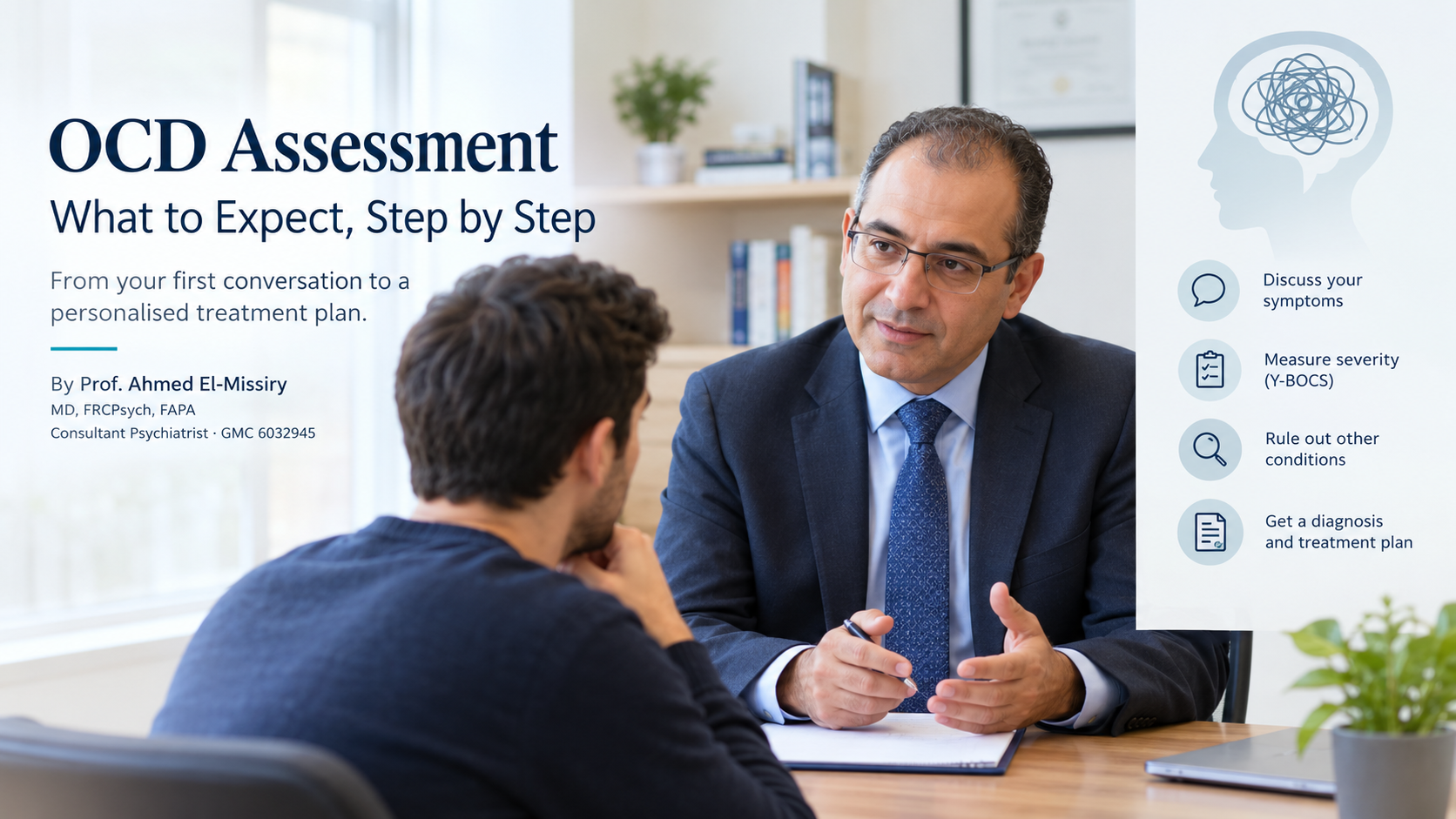
By Prof. Ahmed El-Missiry, MD, FRCPsych, FAPA, Consultant Psychiatrist · GMC 6032945 · Medically reviewed October 2026
Quick answer: An OCD assessment is a structured conversation with a specialist. You’ll be asked about your intrusive thoughts, the rituals or mental habits you use to cope, how much time they take and how they affect your life. Many psychiatrists use a scale called the Y-BOCS to measure severity. Other conditions are ruled out, and you leave with a diagnosis and a treatment plan.
For many people with OCD, the hardest part of an assessment isn’t the time or the cost. It’s the thought of saying their intrusive thoughts out loud.
If that’s you, you’re not alone, and you’re not unusual. Psychiatrists who assess OCD hear about unwanted thoughts of harm, contamination, sex, religion and doubt every week. They know these thoughts are the opposite of what the person wants, and that’s exactly why they’re so distressing.
This guide explains what happens during an OCD assessment in the UK, step by step: what you’ll be asked, how severity is measured, what else is checked, and what you’ll come away with. It reflects how assessments are run for patients seeking a private OCD assessment in London or online with Prof. El-Missiry.
Before the appointment
Most private services send a questionnaire before your first appointment. With Prof. El-Missiry, this is a secure online form covering your symptoms, compulsions, medical history and how daily life is affected. Some people are also asked to complete a short self-report measure such as the OCI-R (Obsessive-Compulsive Inventory, Revised).
It helps to jot down a few things beforehand:
- The main thoughts or fears that keep coming back
- What you do to make the anxiety go away, including things you do in your head
- Roughly how many hours a day it takes up
- Situations, places or people you now avoid
- Any treatment or medication you’ve already tried
You don’t need to write down the content of every intrusive thought. A word or two for the theme is enough.
What the psychiatrist will ask about
Your obsessions
Obsessions are unwanted thoughts, images or urges that keep intruding and cause distress. The psychiatrist will ask what yours are about. OCD tends to latch on to certain themes:
| Theme | What it can look like |
|---|---|
| Contamination | Fear of germs, dirt, illness or bodily fluids |
| Harm | Fear of hurting someone, or of causing harm through carelessness |
| Responsibility and checking | Fear that a door, cooker or plug was left unsafe |
| Sexual or taboo thoughts | Unwanted thoughts that feel shocking or wrong |
| Religious or moral (scrupulosity) | Fear of sinning, blasphemy or being a bad person |
| Symmetry and “just right” | Discomfort until things feel even, ordered or complete |
| Relationships | Persistent doubt about whether you love your partner |
| Health | Repeated fear of having or developing an illness |
Many people have more than one theme, and themes can change over time.
Your compulsions
Compulsions are what you do to reduce the anxiety or prevent what you fear. Some are visible, like washing, checking, cleaning, arranging or repeating actions. Many are invisible: mentally reviewing, counting, praying, replacing a “bad” thought with a “good” one, or seeking reassurance from yourself or others.
The psychiatrist will also ask about avoidance, because staying away from triggers is one of the main ways OCD shrinks someone’s life. They may ask whether family members have changed their routines to help, such as answering the same question repeatedly or washing things for you. This is common, and it’s useful to know.
Time, distress and impact
The questions that matter most for diagnosis are about scale:
- How much time do the thoughts and rituals take each day?
- How distressing are they?
- How much do they interfere with work, study, relationships or looking after yourself?
- How hard do you try to resist them, and how much control do you have?
Everyone has the odd intrusive thought or double-checks a door now and then. OCD is diagnosed when the pattern is time-consuming, distressing or gets in the way of life.
Your history
You’ll be asked when symptoms first appeared, whether they’ve come and gone, and what made them better or worse. OCD often starts in childhood or adolescence, so earlier memories are relevant. The psychiatrist will also ask about previous therapy, medication, physical health, sleep, alcohol and drug use, and family history.
“Will I be judged for my thoughts?”
This is the question people most want answered, and the answer is no.
Intrusive thoughts in OCD are described as ego-dystonic: they clash with your values and you find them upsetting. That’s the opposite of a wish or an intention. A psychiatrist experienced in OCD recognises the difference, and describing a thought about harm isn’t treated as a confession.
You can describe a thought in general terms first, for example “thoughts about harming someone I love”, and add detail when you feel ready. Like all doctors, psychiatrists keep what you say confidential. The only exception is the rare situation where there’s a genuine risk of serious harm, which is a different thing from the unwanted intrusive thoughts of OCD.
How OCD severity is measured: the Y-BOCS
Many psychiatrists use the Yale-Brown Obsessive Compulsive Scale (Y-BOCS), the most widely used measure of OCD severity. It has two parts:
- A symptom checklist to identify which obsessions and compulsions you have
- Ten rated questions: five about obsessions and five about compulsions, each scored 0 to 4
The ten questions cover time spent, interference with life, distress, how much you resist, and how much control you have. The total ranges from 0 to 40:
| Y-BOCS score | Severity |
|---|---|
| 0–7 | Subclinical |
| 8–15 | Mild |
| 16–23 | Moderate |
| 24–31 | Severe |
| 32–40 | Extreme |
The score isn’t a pass or fail. It gives a baseline, helps decide how intensive treatment should be, and is repeated later to show whether things are improving.
How much insight you have
The psychiatrist will also gently explore how you see your fears: do you recognise they’re probably exaggerated, or do they feel completely true? Insight in OCD ranges from good to poor, and occasionally it’s absent. This isn’t a judgement about you. It helps shape treatment and rule out other conditions.
What else is ruled out
Repetitive thoughts and behaviours aren’t unique to OCD. A careful assessment considers whether something else explains them better, or sits alongside OCD:
- Generalised anxiety: worry about real-life problems rather than intrusive, senseless-feeling thoughts
- Depression: low mood often brings ruminating, which can look similar
- Body dysmorphic disorder: a preoccupation with perceived flaws in appearance
- Hoarding disorder: difficulty discarding possessions
- Tic disorders: repetitive movements or sounds, which sometimes occur with OCD
- Autism: routines and repetitive behaviours that feel comforting rather than anxiety-driven
- Obsessive-compulsive personality disorder: perfectionism and rigidity that the person usually sees as reasonable
- Psychosis: beliefs held with complete conviction and without doubt
OCD also commonly travels with other difficulties. If low mood, anxiety or attention problems are part of the picture, the psychiatrist may recommend a depression assessment, an anxiety assessment or an ADHD assessment as part of your care.
What about “Pure O”?
“Pure O” is an informal name for OCD where the compulsions are mainly mental, such as reviewing, checking feelings or neutralising thoughts. It isn’t a separate diagnosis, and it is assessed in exactly the same way. If you think you don’t have compulsions, the psychiatrist will help you spot the mental ones you may not have recognised.
What you’ll leave with
By the end, the psychiatrist will explain whether you have OCD, how severe it is, and any other conditions found. You’ll then agree a plan. NICE guidance (CG31) recommends a stepped approach based on severity:
- Cognitive behavioural therapy (CBT) with exposure and response prevention (ERP): the main psychological treatment, which helps you face triggers gradually without performing the compulsion
- Medication: usually an SSRI antidepressant, often for moderate or severe OCD or when therapy alone isn’t enough. OCD often needs higher doses than depression, and benefit can take up to 12 weeks to show
- Both together: often recommended for more severe OCD
You’ll receive a clinic letter summarising the assessment and plan, copied to your GP if you agree. NICE is updating its OCD guidance, with publication expected from January 2027; your plan will follow current best practice.
How long does it take, and what does it cost?
A private OCD consultation with Prof. El-Missiry lasts 45 to 50 minutes and costs £250, by secure video or at our London clinics in Marylebone, Harley Street and Finsbury Park. You don’t need a GP referral. Klarna interest-free instalments are available, and Prof. El-Missiry is recognised by major insurers including Bupa, AXA Health, Aviva, Vitality and WPA. For a wider view of London psychiatrist fees explained, see our cost guide.
Tips for getting the most from your assessment
- Name your mental rituals. Reviewing, counting, praying or checking feelings all count. They’re often the most important part.
- Be honest about time. “About three hours a day” helps far more than “quite a lot”.
- Mention avoidance. What you no longer do is as telling as what you do.
- Bring a list of past treatment, including any therapy that included ERP and how it went.
- Bring someone if it helps. A partner or family member can describe changes you may not notice.
For general tips that apply to any first appointment, see what a first psychiatric appointment covers.
Frequently asked questions
Can OCD be diagnosed in one appointment?
Often, yes. Where symptoms are clear, a consultant psychiatrist can usually make the diagnosis and agree a plan at the first appointment. If the picture is complicated, a follow-up may be needed.
Do I have to describe my intrusive thoughts in detail?
No. You can start by naming the theme, such as harm or contamination. The psychiatrist needs to understand the pattern, not every word of every thought.
Is the Y-BOCS a test I can pass or fail?
No. It’s a measure of how much OCD affects you right now. It sets a baseline so progress can be tracked during treatment.
Can an OCD assessment be done online?
Yes. OCD is assessed through conversation, so a video consultation covers the same ground as an in-person one. Many people find it easier to talk from home.
Do I need a GP referral?
Not if you’re paying yourself. If you plan to use private health insurance, your insurer may ask for a GP referral and will need to give you a pre-authorisation number first.
Book an assessment
If intrusive thoughts or rituals are taking up your time and energy, you don’t have to keep managing alone. You can book an OCD consultation with Prof. El-Missiry online or in London. If you’d like a broader opinion first, you can also see a private psychiatrist in London.
Call +44 800 970 8017 or message us on WhatsApp.
About the author
Prof. Ahmed El-Missiry is a consultant psychiatrist with 30 years’ experience, a Fellow of the Royal College of Psychiatrists and the American Psychiatric Association, and a Professor of Psychiatry. He trained at Guy’s and St Thomas’ and King’s College London, assesses and treats OCD in adults, and sees patients in English and Arabic. Read verified patient reviews on Doctify.
Further information: NICE guideline CG31, NHS: OCD and the charity OCD-UK. This article is general information, not personal medical advice. If you are in crisis, call NHS 111 (option 2), Samaritans on 116 123, or 999.
