By Prof. Ahmed El-Missiry, MD, FRCPsych, FAPA, Consultant Psychiatrist · GMC 6032945 · Medically reviewed October 2026
Quick answer: After an ADHD diagnosis in the UK, you receive a written report and agree a treatment plan with your specialist. That may include learning about ADHD, practical strategies, therapy and, if you choose, medication. Medication starts with health checks and a few weeks of careful dose adjustment (titration). Your GP may later take over prescribing through shared care, with regular reviews.
The day you’re diagnosed with ADHD can feel like an ending and a beginning at once. An ending to years of wondering why ordinary things felt so hard. A beginning of a new set of questions: What now? Do I need medication? Who prescribes it? Do I have to tell work?
This guide answers those questions in the order they usually come up. It’s written for adults in the UK, and it reflects the pathway patients follow after a consultant-led ADHD assessment in London with Prof. El-Missiry, in line with NICE guidance.
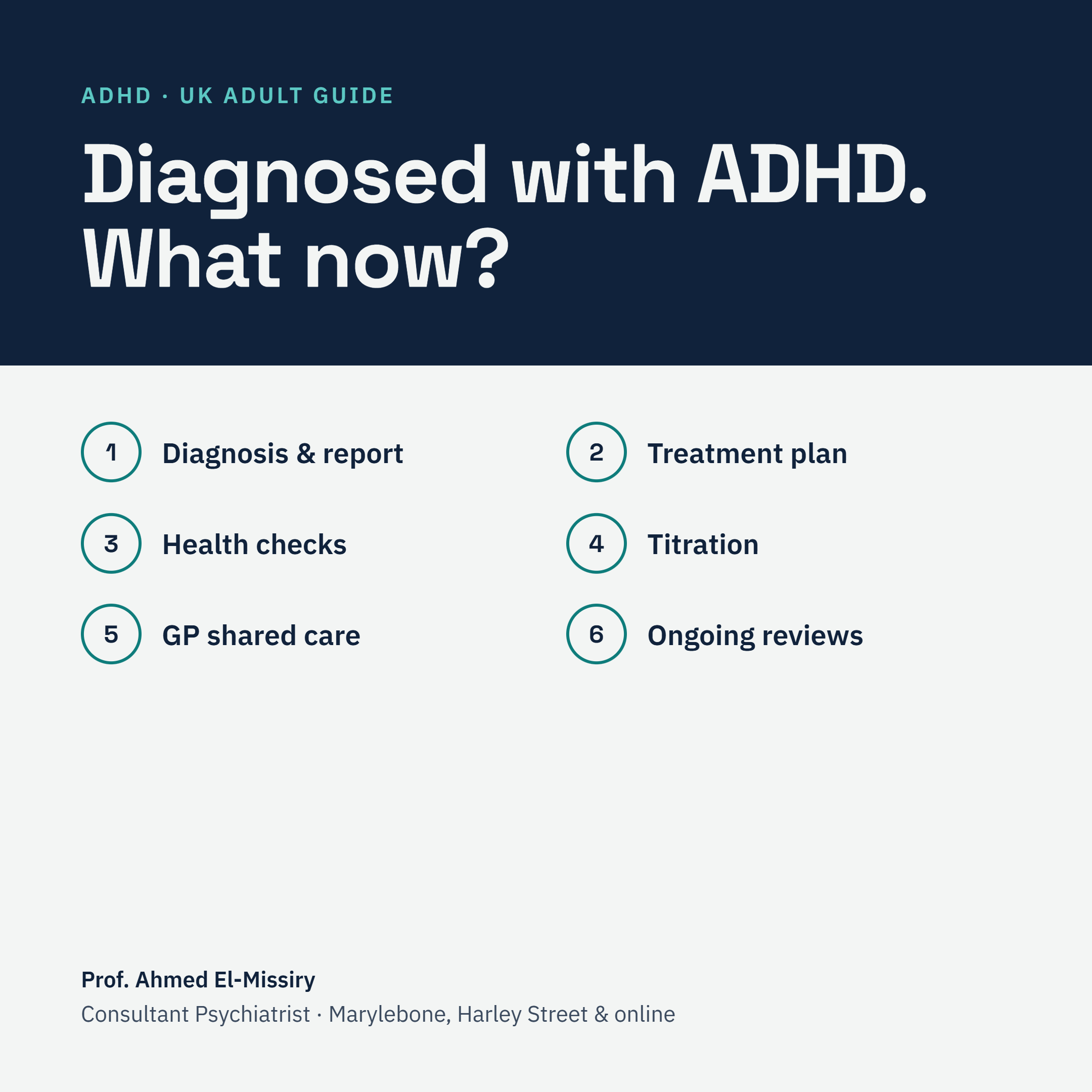
The stages at a glance
| Stage | When | What happens |
|---|---|---|
| 1. Diagnosis and report | At or shortly after the assessment | You’re told the outcome and receive a written report |
| 2. Treatment discussion | Same appointment or a follow-up | Options are explained; you decide together |
| 3. Baseline health checks | Before any medication | Blood pressure, pulse, weight, heart history |
| 4. Titration | Usually several weeks | Dose adjusted gradually with regular reviews |
| 5. Stable treatment | Once the right dose is found | Clinic letter to your GP; shared care requested |
| 6. Ongoing monitoring | Every 6 to 12 months | Physical checks and specialist review |
Not everyone goes through every stage. If you decide against medication, stages 3 to 5 don’t apply.
Your diagnosis report: what it should include
A good ADHD report isn’t a one-line confirmation. It’s a document you’ll use for years, with your GP, employer, university and future clinicians. It should set out:
- The diagnosis and presentation: predominantly inattentive, predominantly hyperactive-impulsive, or combined
- The evidence: your current symptoms, childhood history and how difficulties affect at least two areas of life
- Other conditions considered: for example anxiety, depression, sleep problems or trauma, and whether they were ruled out or found alongside ADHD
- Recommendations: treatment options, practical adjustments and next steps
Read it carefully, and ask if anything is unclear. If a fact is wrong, ask for it to be corrected; the report will be relied on by others.
Making sense of the diagnosis
People react in very different ways. Many feel relief. Some feel frustrated that it took so long, or sad thinking back over school, jobs or relationships. Others feel a bit unsettled by the label. All of these are normal, and they often change over the following weeks.
Understanding how ADHD affects you in particular is the foundation for everything that follows. NICE calls this psychoeducation, and it’s usually the first part of any plan. If you’re curious about the standards your diagnosis was made against, our guide to the NICE NG87 guideline explained sets them out in plain English.
Treatment options: it’s not only medication
A diagnosis doesn’t mean you must take medication. NICE guidance (NG87) recommends that adults first have the chance to make practical and environmental changes, and that medication is considered if ADHD still causes significant difficulties after those changes. Your options usually include:
- Psychoeducation: understanding your own pattern of strengths and difficulties
- Practical and environmental changes: routines, reminders, reducing distraction, breaking tasks down, adjustments at work
- Psychological support: for example CBT adapted for ADHD, or coaching focused on organisation and planning
- Medication: for adults whose symptoms still cause significant impairment
- Treatment for coexisting conditions: such as anxiety, low mood or insomnia
The right mix depends on your symptoms, your circumstances and what you prefer. You can change your mind later.
If you choose medication: the health checks first
Before any ADHD medicine is prescribed, your psychiatrist will do a baseline physical assessment. This normally includes:
- Blood pressure and heart rate
- Weight (and height)
- Questions about your heart health and any family history of heart problems or sudden death
- A review of all your current medicines, alcohol and substance use
An ECG (heart tracing) isn’t routine for everyone. It’s arranged if your history or examination suggests a heart concern. Having a home blood pressure monitor is very helpful, because readings are taken repeatedly over the following weeks.
What is ADHD titration?
Titration means starting on a low dose and adjusting it step by step until you reach the dose that works best with the fewest side effects. It’s the most important part of starting treatment, and it shouldn’t be rushed.
For most adults, the first medicine offered is one of two stimulants: lisdexamfetamine or methylphenidate. Both are long-established and widely used in the UK. If the first doesn’t work well enough after an adequate trial (NICE suggests around six weeks at a suitable dose), the other is usually tried. Non-stimulant options such as atomoxetine are considered if stimulants aren’t suitable or aren’t tolerated.
During titration you’ll typically:
- Take the medicine at a set dose for a short period, often a week or so, before any change
- Record your blood pressure, pulse and any side effects
- Note changes in focus, organisation, restlessness, mood and sleep
- Have regular reviews (often by video) to decide whether to adjust the dose
Common early side effects include reduced appetite, difficulty sleeping, headaches and a raised heart rate. Many settle within a few weeks, and some improve with a change of dose or timing. Never change your dose or stop suddenly without speaking to your prescriber.
Titration usually takes somewhere between several weeks and a few months, depending on how you respond.
Prescriptions for ADHD medicine: the practical bits
Stimulant ADHD medicines are Schedule 2 controlled drugs in the UK. In practice that means:
- Prescriptions are usually for up to 30 days’ supply at a time
- A prescription must be dispensed within 28 days of the date it’s written
- Repeat prescriptions can’t be stockpiled, so order in good time
- If you’re travelling abroad with your medicine, check the rules for your destination before you go
The availability of specific brands and strengths can vary between pharmacies. If your pharmacy can’t supply your usual product, speak to your prescriber rather than changing anything yourself.
GP shared care: what it is and what to expect
Once your dose is stable, your psychiatrist will usually write to your GP and ask whether they’ll take over prescribing under a shared care agreement. Your GP then issues the repeat prescriptions and does routine checks, while the specialist stays involved for reviews and advice. You pay the standard NHS prescription charge (in England) instead of private medicine prices.
Two things to know:
- Shared care is voluntary. GPs can decline, and local policies differ across England. It’s worth asking your surgery about its position before or soon after your diagnosis.
- A declined request isn’t the end of treatment. If your GP says no, prescribing can continue privately. With Prof. El-Missiry, an ADHD repeat prescription after a short clinical review is £75, without booking a full appointment each time.
Ongoing monitoring
ADHD treatment isn’t “set and forget”. Once you’re stable, expect:
- Blood pressure, pulse and weight checks about every six months, by your GP under shared care or by your specialist
- A specialist review at least once a year to check the medicine is still helping, side effects are acceptable, and the dose is still right
- A periodic conversation about whether you still need medication. Some people take breaks or reduce over time; others benefit long term
Contact your prescriber sooner if you notice chest pain, palpitations, a big change in mood, or significant weight loss.
Conditions that often come with ADHD
ADHD frequently travels with other difficulties, especially anxiety, low mood and sleep problems. Treating ADHD sometimes improves these, but not always, and they can need their own treatment. If your assessment found something alongside ADHD, it may help to look at anxiety assessment, depression assessment or insomnia treatment. If you’re not sure what’s driving your symptoms, a broader appointment with a private psychiatrist in London can untangle it.
Work and study after diagnosis
ADHD can count as a disability under the Equality Act 2010 if it has a substantial and long-term effect on your day-to-day activities. If so, your employer must consider reasonable adjustments, such as a quieter workspace, written instructions, flexible deadlines or regular check-ins.
You don’t have to tell your employer. If you do, the government’s Access to Work scheme may fund practical support. Students in higher education can ask their university’s disability service about support, including Disabled Students’ Allowance in England.
Driving
You must tell the DVLA if your ADHD, or your ADHD medication, affects your ability to drive safely. If it doesn’t, you don’t need to tell them. You can be fined up to £1,000 for not reporting a condition that affects safe driving. If you’re unsure, ask your psychiatrist, and see the GOV.UK guidance on ADHD and driving.
Who else should you tell?
That’s your choice. Many people tell a partner or close family first, because understanding ADHD often changes how small daily frictions are handled at home. Some share the report with their employer to request adjustments. Others keep it private. There’s no right answer.
What does follow-up cost with us?
| Item | Fee |
|---|---|
| Adult or adolescent ADHD assessment | £370 |
| ADHD assessment with computerised testing | £470 |
| Follow-up and titration reviews | Confirmed when you book |
| ADHD repeat prescription (no appointment) | £75 |
Klarna interest-free instalments are available for eligible appointments. Prof. El-Missiry is recognised by Bupa, AXA Health, Aviva, Vitality, WPA and Allianz Worldwide Care; insured patients need pre-authorisation using GMC number 6032945.
What if the assessment says it isn’t ADHD?
That’s a valid and useful outcome. A careful assessment will explain what else may be causing your difficulties, such as anxiety, low mood, sleep problems or trauma, and what can help. If you’re still at the stage of preparing for your ADHD assessment, our checklist guide covers what to bring and expect.
Frequently asked questions
How long does ADHD titration take?
Usually several weeks to a few months. It depends on how you respond to the first medicine, whether the dose needs several adjustments, and whether a different medicine needs to be tried.
Will I have to take ADHD medication for ever?
No. Medication is reviewed at least once a year, including whether you still need it. Some people take it long term because it helps; others reduce or stop. Any change should be planned with your prescriber.
Does my GP have to accept shared care?
No. Shared care is a voluntary arrangement, and GP practices can decline. If they do, your specialist can continue prescribing privately.
Is a private ADHD diagnosis valid in the UK?
Yes. A diagnosis made by a suitably qualified specialist after a full assessment in line with NICE NG87 is a genuine clinical diagnosis. What isn’t automatic is GP agreement to shared care.
Do I have to tell my employer I have ADHD?
No. It’s your choice. Telling them may help you get reasonable adjustments, and you can decide how much to share.
Next steps
If you think ADHD might explain a lifetime of difficulties with focus, organisation or restlessness, a careful assessment is the place to start. You can book an ADHD assessment with Prof. El-Missiry in Marylebone, Harley Street, Finsbury Park or online across the UK.
Call +44 800 970 8017 or message us on WhatsApp.
About the author
Prof. Ahmed El-Missiry is a consultant psychiatrist with 30 years’ experience, a Fellow of the Royal College of Psychiatrists and a Professor of Psychiatry. He trained at Guy’s and St Thomas’ and King’s College London, assesses and treats ADHD in adults and adolescents, and sees patients in English and Arabic. Read verified patient reviews on Doctify.
This article is general information, not personal medical advice. Never start, stop or change ADHD medication without speaking to your prescriber. If you are in crisis, call NHS 111 (option 2), Samaritans on 116 123, or 999.