Booking a private ADHD assessment is the easy part. Turning up ready to describe a lifetime of attention, energy and organisation patterns in a 60 to 120 minute conversation is where people tend to stumble. Not because they are doing anything wrong, but because ADHD is diagnosed from your history, and most of us have never sat down and pulled that history together.
This guide walks you through exactly how to prepare, from checking your clinician before you pay, to the documents worth digging out, to what to do on the day. It is written for adults in the UK, with specific notes for London and England, and it includes printable checklists you can copy straight into your notes app.
Quick answer: how do you prepare for a private ADHD assessment in the UK?
Choose a GMC-registered specialist who follows NICE guideline NG87. Complete the pre-assessment forms honestly. Gather childhood evidence such as school reports, and line up someone who knew you as a child to give a second view. List your medicines, medical history and family history. Before you pay, ask what the fee includes: the written report, medication titration, and whether NHS shared care is supported.
In this guide
- What a private ADHD assessment actually involves
- Private, NHS or Right to Choose: which route suits you?
- Checklist 1: Before you book
- Checklist 2: Evidence and documents to gather
- Bringing a second voice: the informant
- What you will be asked (and how to answer well)
- Anxiety, depression and other conditions that overlap
- Checklist 3: The week and the day of your appointment
- Preparing in London and across England
- What happens after the assessment
- Common mistakes to avoid
- Frequently asked questions
What a private ADHD assessment actually involves
Attention deficit hyperactivity disorder (ADHD) is a neurodevelopmental condition. That means it starts in childhood, even if it went unnoticed, and it shapes how your attention, impulse control, energy levels and emotional regulation work across your life. There is no blood test or scan that confirms it. A diagnosis is a clinical judgement made by a trained specialist after a detailed look at your history.
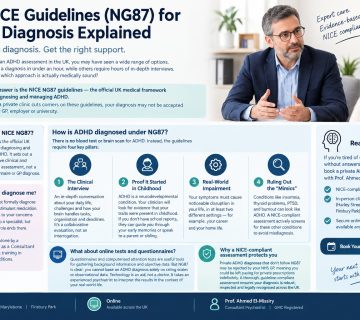
In the UK, the benchmark for how this should be done is the National Institute for Health and Care Excellence guideline on ADHD, known as NICE NG87. In plain terms, it expects a comprehensive assessment by a specialist with ADHD training, covering your current symptoms, how they affect daily life, your developmental and childhood history, your mental and physical health, and any other conditions that could explain or accompany what you are experiencing.
A good assessment will usually involve four things:
- Pre-assessment questionnaires completed before you meet the clinician.
- A structured clinical interview, often lasting 60 to 120 minutes, exploring symptoms in childhood and adulthood.
- Collateral information, such as a parent, partner or old school reports.
- A written report setting out the diagnosis (or the reasons ADHD was not diagnosed) and the recommended next steps.
For adults, current diagnostic frameworks look for a persistent pattern of inattention and/or hyperactivity-impulsivity, with signs that began in childhood, show up in more than one area of life, and cause real difficulty. The assessor also needs to be confident that something else, such as anxiety, depression, trauma or a medical issue, is not the better explanation.
If you would like to see how this works with a consultant psychiatrist, the page on private ADHD assessment with Prof. El-Missiry explains the process, from questionnaire to review.
Private, NHS or Right to Choose: which route suits you?
Before you prepare for anything, it is worth being clear about why you are going private and what you expect afterwards. The three routes in England look like this:
| Route | Cost to you | Typical wait | Things to know |
|---|---|---|---|
| Standard NHS referral via your GP | Free | Often years in many areas; varies hugely by local service | Your local waiting time depends on where you live. |
| NHS Right to Choose (England only) | Free, NHS-funded | Anything from weeks to well over a year depending on provider | Some integrated care boards (ICBs) have capped or paused referrals, so check your local position first. |
| Private (self-funded) | Fee payable; commonly several hundred pounds up to well over £1,000 | Often days to a few weeks | Medication costs and NHS shared care need discussing up front. |
Waiting times and local rules have been shifting. The independent ADHD Taskforce published its final report in November 2025, and NHS England has said it is working with local systems on access. Because policy and ICB decisions change, treat any wait time or price you read online, including in this article, as a guide to verify rather than a promise.
One point that catches people out: a diagnosis from a properly qualified private specialist is a genuine clinical diagnosis. What is not automatic is your GP agreeing to take over prescribing through a shared care agreement. That decision sits with the practice and local ICB policy. Ask about it before you book, not afterwards.
Checklist 1: Before you book
Preparation starts with choosing well. A strong assessment is far easier to prepare for, and far more useful afterwards, than a rushed one.
- ☐ Check who will assess you. Look the clinician up on the GMC register. For a psychiatrist, you can see whether they are on the specialist register and what their qualifications are. Confirm they have experience of adult ADHD specifically.
- ☐ Check the service is regulated. Independent healthcare providers in England are inspected by the Care Quality Commission. Ask whether the provider or clinician is registered and how to find that registration.
- ☐ Ask how long the assessment lasts. A thorough adult assessment takes more than a quick chat. If you are offered a very short slot, ask how they will cover childhood history and co-existing conditions.
- ☐ Ask what tools are used. Many clinicians use a structured interview such as DIVA-5 alongside rating scales and a clinical history. You do not need to know them in detail, but a clinician should be able to explain their method.
- ☐ Ask exactly what the fee covers. Written report? A copy sent to your GP? Follow-up appointment? Is it a diagnosis-only price?
- ☐ Ask about medication. If you are diagnosed and medication is suitable, who starts it, who adjusts the dose, and what does each review and private prescription cost?
- ☐ Ask about shared care. Will the clinician write to your GP, and do they support a shared care arrangement? Then check your own GP surgery’s current position.
- ☐ Check the format. Online video, in person, or both. Confirm what you need (device, private room, ID).
- ☐ Clarify the cancellation and rescheduling terms. It is much easier to ask before paying.
Checklist 2: Evidence and documents to gather
ADHD is a lifelong pattern, so the assessor needs a picture of you across time, not just right now. Nobody expects a perfect archive. Even a few pieces of evidence can make the conversation sharper and the report more convincing to a GP or employer later.
Childhood and education
- ☐ Old school reports, especially primary school ones. Comments such as “easily distracted”, “could do better if he/she concentrated”, “talkative” or “daydreams” are exactly what clinicians look for.
- ☐ Any records of an educational psychologist, SENCo involvement, or learning support.
- ☐ Childhood medical records or health visitor notes, if you can request them.
- ☐ A short list of what you remember: lost belongings, forgotten homework, restlessness in class, trouble waiting your turn, intense bursts of focus on things you loved.
Adult life
- ☐ Work appraisals, performance reviews, or feedback about missed deadlines, disorganisation or inconsistent output.
- ☐ A rough job history, including why jobs ended or why you moved on.
- ☐ University or college records, including any extensions or resits.
- ☐ Examples of money, admin and household struggles: late fees, unopened post, missed renewals, impulse purchases.
- ☐ Driving history, if relevant (speeding, minor accidents, concentration lapses).
Health
- ☐ A list of every medicine and supplement you take, with doses.
- ☐ Past and current diagnoses, including anxiety, depression, sleep problems, thyroid issues, epilepsy or migraines.
- ☐ Any history of heart problems, high blood pressure or fainting, in you or close relatives. This matters if stimulant medication is considered later.
- ☐ Family history of ADHD, autism, bipolar disorder, addiction or other mental health conditions.
- ☐ Honest notes on alcohol, nicotine, cannabis, caffeine and any other substances. Clinicians ask without judgement because it affects both diagnosis and treatment safety.
Bringing a second voice: the informant
Many assessors ask for an informant, which means someone who can describe what you were like as a child, or how you come across now. This is usually a parent, an older sibling, or a long-term partner or close friend.
Why does this matter? Because ADHD is often hard to see from the inside. You may have spent decades compensating, masking or simply assuming everyone finds these things this hard. Another person can often recall things you have forgotten or never noticed.
Tips for choosing and briefing your informant:
- Pick someone who knew you before the age of about 12 if possible.
- Ask them to be honest rather than flattering or protective. A kind but vague answer does not help you.
- Tell them what to expect: a questionnaire, a short phone or video call, or both.
- If no parent or relative is available, a teacher, older friend or anyone else who knew you then can sometimes help. Tell your clinician, and they will advise on what is acceptable.
Not having an informant is not a barrier to assessment. It simply means the clinician will rely more heavily on other sources and your own account.
What you will be asked (and how to answer well)
Expect to talk through your life in detail. A structured interview usually moves through attention problems and hyperactivity-impulsivity symptoms, then asks for real examples from childhood and from adulthood in areas such as work or education, relationships and family, social life, free time, and your sense of self-confidence.
You may be asked things like:
- “Tell me about a typical school day when you were around nine or ten.”
- “How do you handle starting a task you find boring?”
- “What happens when someone is talking to you and your mind wanders?”
- “How do you cope with deadlines, paperwork and appointments?”
- “What helps you cope, and what do you hide from others?”
How to give useful answers
- Be specific. “I’m disorganised” tells a clinician little. “I have three half-finished projects, I missed my car MOT twice this year and I use sticky notes that I then lose” tells them a lot.
- Describe your worst days and your typical days. Do not only describe how you cope when you are well rested and highly motivated.
- Say what you are masking. Many adults, particularly women, have built elaborate systems and routines just to appear organised. Explain what it costs you in energy.
- Do not exaggerate or minimise. The clinician is not trying to catch you out. The aim is accuracy, and an accurate picture protects you if a GP or employer later reads your report.
- It is fine to say “I don’t remember”. You can then suggest who might.
Anxiety, depression and other conditions that overlap
This is the part people often do not expect. ADHD rarely travels alone. Anxiety, low mood, sleep problems and trauma can mimic ADHD, can be caused by living with undiagnosed ADHD, or can simply sit alongside it. Sorting out which is which is a big part of a skilled assessment.
For example, difficulty concentrating can come from ADHD, but also from persistent worry, poor sleep, depression, thyroid problems or the effects of stress. Restlessness can reflect hyperactivity or anxiety. A specialist will want to understand when your difficulties began, whether they were present in childhood, and whether they come and go with your mood.
If anxiety is a major part of your picture, it can help to look at it properly in its own right. You can read about a psychiatrist-led anxiety assessment if worry, panic or constant tension is shaping your daily life. Depending on your situation, one consultation may be able to consider both, which is why it helps to tell your clinician everything up front.
Conditions that your clinician may want to explore alongside ADHD include:
- Anxiety disorders, including generalised anxiety and panic
- Depression and bipolar disorder
- Post-traumatic stress disorder and complex trauma
- Autism (the two often co-occur)
- Sleep disorders, including insomnia
- Substance or alcohol use
- Medical causes such as thyroid problems, anaemia or side effects of other medicines
Do not self-diagnose from social media or online quizzes. A free screening questionnaire can be a useful prompt to seek assessment, but it cannot confirm or rule out ADHD.
Checklist 3: The week and the day of your appointment
In the week before
- ☐ Finish and submit every pre-assessment form on time. Late forms can delay your appointment.
- ☐ Write a one-page summary: your top five struggles, when you first noticed them, and two or three clear examples for each.
- ☐ Write down your questions for the clinician (diagnosis, medication, report, shared care, workplace support).
- ☐ Confirm your informant is available and has been contacted if the clinic requires it.
- ☐ Keep your usual routine with medicines, sleep and caffeine. Do not stop any prescribed medicine without medical advice, and tell the clinician about everything you take.
- ☐ Check your GP details, address and NHS number, as many clinics request them.
On the day: online appointments
- ☐ Test your camera, microphone and internet connection 15 minutes beforehand.
- ☐ Choose a quiet, private space. In a shared flat or house, let others know you must not be disturbed, and use headphones.
- ☐ Have photo ID ready if the clinic asks for it.
- ☐ Keep your summary, medicine list and documents beside you, along with water and a notepad.
- ☐ Silence phone notifications and close other tabs. If you struggle with long calls, you can tell the clinician and ask for a short break.
On the day: in-person appointments
- ☐ Plan your route and leave extra time. Central London travel delays are common.
- ☐ Bring ID, your medicine list and any printed documents.
- ☐ Eat beforehand and bring water.
A few minutes after the appointment, write down anything you forgot to say, along with anything you want to follow up. If you do remember something important, most clinics are happy to take a short written addition.
Preparing in London and across England
If you are in London, you already have many private options, from online services to consulting rooms in Marylebone, Harley Street and elsewhere in the capital. Because a large share of private assessments are now delivered by video, you can usually choose by quality and fit rather than by postcode.
A few London and England-specific points:
- Know your ICB. London is covered by five integrated care systems (North West, North Central, North East, South East and South West London). Shared care policies and Right to Choose arrangements can differ between areas, so ask your surgery for its current policy on ADHD shared care before you commit to a private pathway.
- Right to Choose applies to England only. If you live in Scotland, Wales or Northern Ireland, the NHS pathways are different.
- Online works across England. A video consultation lets you see a consultant without commuting, which many Londoners find easier around work and caring responsibilities. If you prefer face-to-face, ask whether in-person appointments in central London are available.
- Keep GP records handy. If you changed GP when you moved to or within London, collect the details for previous practices in case the clinician asks about earlier consultations.
What happens after the assessment
You will usually receive a written report. If ADHD is diagnosed, it should explain the diagnosis, your presentation (inattentive, hyperactive-impulsive or combined), any co-existing conditions, and the recommended next steps. If ADHD is not diagnosed, a good report explains why and what else might help.
Treatment is a shared decision. NICE guidance describes a mix of psychoeducation, practical and environmental changes, psychological support and, for many adults, medication. If medication is appropriate, clinicians typically carry out baseline health checks first, such as blood pressure, pulse, height and weight, then adjust the dose gradually (titration) over several weeks before things stabilise.
After a diagnosis, consider the following:
- Your GP. Share the report and ask whether they will agree to shared care. Prescribing responsibility is their decision, even though the diagnosis stands.
- Your workplace. ADHD can count as a disability under the Equality Act 2010 if it has a substantial and long-term effect on daily activities, which may entitle you to reasonable adjustments. The government’s Access to Work scheme may help with practical support. You are not automatically obliged to tell your employer, so decide what suits you.
- Driving. If your symptoms or medicines could affect safe driving, check the current DVLA guidance on ADHD and driving.
- Follow-up. Book your review dates now. Dose adjustments and side-effect checks matter in the first months.
If you are ready to take the next step, you can book an online ADHD assessment or read more about the service first. Prof. Ahmed El-Missiry is a consultant psychiatrist with more than 30 years of experience, and the approach is built around a full history, careful diagnosis and a clear plan afterwards.
Common mistakes to avoid
- Choosing on price alone. A very cheap, very short assessment may leave you with a report your GP or employer will not rely on.
- Treating it like a test. You cannot pass or fail. Over-rehearsing answers can make the picture less accurate.
- Leaving out the awkward bits. Substance use, emotional outbursts, relationship difficulties and money problems are all relevant. They are not shameful.
- Stopping medication on your own. Always speak to a doctor before changing prescribed medicines.
- Not asking about aftercare. A diagnosis without a plan for treatment, review and GP communication can leave you stuck.
- Expecting a “yes”. A thorough clinician may conclude that something other than ADHD is at play. That is still useful, and it can point you towards the right help sooner.
Frequently asked questions
How long does a private ADHD assessment take?
Most thorough adult assessments run for roughly 60 to 120 minutes, in addition to the questionnaires you complete beforehand. Some providers split the process across more than one appointment.
Do I need a GP referral for a private ADHD assessment?
Many private clinics will see you without a referral. However, it is sensible to tell your GP, particularly if you hope for NHS shared care later, because the clinician will usually write to them.
Is an online ADHD assessment as valid as an in-person one?
Yes, when it is carried out by a suitably qualified specialist using a thorough structured process. Video assessments are widely used across the UK. Your clinician will say if they feel anything must be done face to face.
What if I have no childhood records or my parents are no longer around?
You can still be assessed. The clinician will lean more on your own detailed account and on any other people or evidence available, such as older siblings, friends or old documents.
Will the NHS accept my private ADHD diagnosis?
A diagnosis made by a qualified specialist is a genuine clinical diagnosis. Whether your GP takes on prescribing under shared care depends on the practice and local ICB policy, so check this before booking.
How much does a private ADHD assessment cost in the UK?
Prices vary widely. Published fees for adult assessments commonly start from a few hundred pounds and can exceed £1,000, with in-person central London appointments often at the higher end. Always ask what is included, and whether treatment and medication reviews are charged separately.
Can anxiety or depression be mistaken for ADHD?
Yes. They share symptoms such as poor concentration and restlessness, and they can also exist alongside ADHD. This is why a careful assessment looks at your whole history rather than a single list of symptoms.
What if I am told I do not have ADHD?
That is a valid outcome. A good clinician will explain their reasoning and suggest other explanations or support, which may include assessment for anxiety, mood disorders, trauma or autism.
Should I stop caffeine or my medicines before the assessment?
No. Keep your normal routine and be open about what you take. Never stop prescribed medicine without medical advice.
Do I have to tell my employer or the DVLA?
There is no blanket duty to tell your employer, although you may choose to in order to request adjustments. For driving, the DVLA expects you to notify them in certain circumstances, such as where symptoms or treatment affect safe driving. Check the current gov.uk guidance or ask your clinician.
If you are in crisis: if you or someone else is in immediate danger, call 999. In England you can also call NHS 111 and choose the mental health option, or call Samaritans free on 116 123, at any time.
Ready to get started?
Preparing well turns a stressful appointment into a productive one. If you think ADHD may explain a lifetime of struggling with focus, organisation or restlessness, a consultant-led assessment is the most reliable way to find out, and a clear report gives you something solid to act on.
You can find out more and book through the ADHD assessment page. If worry, panic or constant tension is a big part of your story, the anxiety assessment page explains how that is evaluated. For an overview of every service, visit the Prof. El-Missiry home page.
About the author and medical review
Prof. Ahmed El-Missiry is a consultant psychiatrist with more than 30 years of experience, whose qualifications include MD, FRCPsych and MSc (Neuropsychiatry), and who has expertise in ADHD, anxiety, depression, PTSD, OCD and addiction. He is a Professor of Psychiatry and has contributed to published ADHD research. He offers confidential online psychiatric appointments. Learn more about Prof. El-Missiry.
Medical disclaimer: this article is for general information and does not replace personal medical advice, diagnosis or treatment. Prices, waiting times and NHS policies change, so check current details with the provider, your GP and your ICB.
Sources and further reading
- NICE guideline NG87: Attention deficit hyperactivity disorder: diagnosis and management
- NHS: Attention deficit hyperactivity disorder (ADHD)
- NHS England: response to the ADHD Taskforce final report (6 November 2025)
- General Medical Council: check a doctor’s registration
- Care Quality Commission
- GOV.UK: Access to Work
- GOV.UK: ADHD and driving