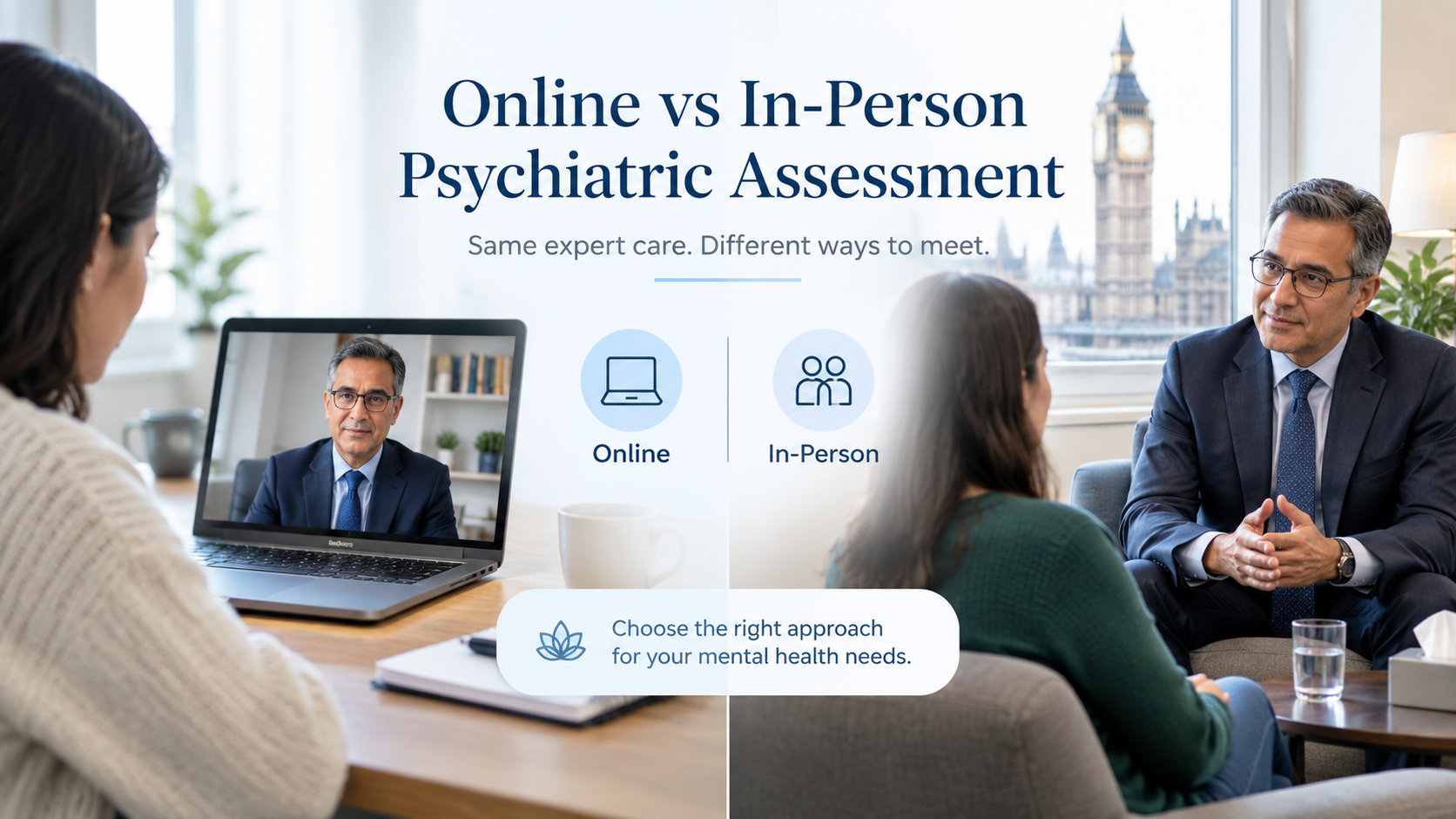
Choosing how to get evaluated for a mental health concern can feel like its own small crisis on top of the one that brought you here. Do you sit across from a psychiatrist in an office, or do you log into a video call from your bedroom? Both are legitimate, both are widely used today, and both can lead to an accurate diagnosis and a workable treatment plan. The right choice just depends on your situation, not on which option is “better” in some universal sense.
This guide breaks down how the two formats actually differ, who tends to benefit most from each, and what to weigh before you book your first appointment.
What a Psychiatric Assessment Actually Involves
Before comparing formats, it helps to know what you’re walking into either way. A first psychiatric assessment usually covers:
- Your current symptoms and how long they’ve been present
- Personal and family mental health history
- Physical health, medications, and substance use
- Sleep, appetite, mood, energy, and concentration patterns
- Life circumstances — work, relationships, stressors
- A discussion of possible diagnoses and next steps
The clinical content of the session is largely the same whether it happens on a screen or in a room. What changes is the experience of getting there.
🏥 In-Person Psychiatric Assessment: The Traditional Route
✅ Strengths
Non-verbal cues are easier to read. A psychiatrist sitting in the same room can notice posture, tremor, restlessness, eye contact, and subtle shifts in affect that a camera sometimes flattens or misses.
Physical exams are simpler. If your presentation suggests a medical cause needs ruling out — thyroid issues, neurological signs, medication side effects — an in-person visit allows for direct examination rather than a verbal description.
Fewer technical variables. No frozen screens, no lag, no “can you hear me now?” moments interrupting a sensitive conversation.
Some people simply focus better away from home. A dedicated clinical space, free of household distractions, can make it easier to open up.
⚖️ Trade-Offs
- Requires travel time, which matters more if you’re dealing with low energy, anxiety, or a demanding schedule
- Appointment availability is tied to a physical location
- Waiting rooms can feel exposing for people anxious about being seen seeking psychiatric care
💻 Online Psychiatric Assessment: The Modern Alternative
✅ Strengths
Access from anywhere. This matters enormously for people in areas with few psychiatrists nearby, for those with mobility limitations, or for anyone whose work or caregiving schedule makes in-person visits hard to fit in.
Lower barrier to starting. For many people, the hardest part of getting help is the first step. Booking a video call from a familiar, private space removes friction that a clinic visit doesn’t.
Comparable diagnostic accuracy for most presentations. Research into telepsychiatry has consistently found that diagnostic agreement between video and in-person assessment is high for the majority of common conditions, including depression, anxiety disorders, and ADHD evaluations.
Continuity is easier. Follow-ups, medication reviews, and check-ins can happen without rearranging your whole day around a commute.
⚖️ Trade-Offs
- Requires a stable internet connection and a private space to talk
- Not always suitable for assessments needing a physical exam
- Some conditions — active psychosis, significant safety risk, certain neurological presentations — are generally better assessed in person, at least initially
- A minority of people find it harder to build rapport through a screen
Which One Should You Choose?
There’s no single right answer, but a few questions can help you decide.
|
🏥 Choose In-Person If:
|
💻 Choose Online If:
|
For many people, the practical answer is a mix: an initial assessment done however is most accessible, with the format revisited at follow-up if it isn’t working well.
What Matters More Than the Format
Regardless of which setting you choose, a few things matter more than whether the appointment is online or in-person:
The clinician’s qualifications and experience with your specific concern
Whether you feel heard, not rushed through a checklist
A clear explanation of diagnosis and options, not just a prescription handed over
A plan for follow-up, since a single assessment is rarely the end of the process
A well-run online assessment with an experienced psychiatrist will generally serve you better than a rushed in-person one, and vice versa. The format is a logistics decision; the clinician is the clinical one.
Ready to Talk to Someone?
A private psychiatrist offering both online and in-person assessments means you’re not locked into one format before you’ve even had a first conversation.
Not sure yet whether your symptoms even warrant a psychiatric consultation, or whether private care is the right route compared with going through the NHS? Two related guides may help you think it through before you book anything:
- When Should You See a Private Psychiatrist? Signs to Look Out For — a practical rundown of the signs that suggest it’s time to seek an assessment, whichever format you choose
- Private Psychiatrist vs NHS Psychiatrist: What Is the Difference? — useful if you’re also weighing private versus NHS care alongside the online-versus-in-person decision
If you’re specifically looking into a particular condition, the assessment pages for
ADHD,
anxiety,
depression,
bipolar disorder,
PTSD, and
OCD
each go into more depth on what that specific assessment involves, in either format.
Frequently Asked Questions
Is an online psychiatric assessment as accurate as an in-person one?
For most common conditions — depression, anxiety, ADHD, and many mood disorders — studies show video-based assessments reach the same diagnostic conclusions as in-person ones in the large majority of cases. Exceptions arise mainly when a physical exam or direct observation of severe symptoms is clinically necessary.
Can a psychiatrist prescribe medication after an online assessment?
In most jurisdictions, yes. Licensed psychiatrists can prescribe following a video consultation, subject to local regulations on controlled substances, which sometimes have additional requirements.
How long does a first psychiatric assessment take?
Typically 45–60 minutes for an initial assessment, whether online or in-person, with shorter follow-up appointments afterward.
What if I start online and decide I’d prefer in-person, or vice versa?
Most practices that offer both formats let you switch between appointments as needed — there’s usually no reason you have to commit to one format for the entire course of care.
Is online psychiatric care private and secure?
Reputable providers use encrypted, healthcare-compliant video platforms, and the same confidentiality standards that apply to in-person psychiatric care apply online.
You Might Also Like
|
Private Psychiatrist vs NHS Psychiatrist: What Is the Difference? Breaks down cost, waiting times, and continuity of care between the two routes. |
When Should You See a Private Psychiatrist? Signs to Look Out For A clear, no-pressure guide to recognising when it’s time to book an assessment. |
What Is a Private Psychiatrist and What Do They Do? A foundational explainer if you’re new to private psychiatric care. |
This article is for general informational purposes and isn’t a substitute for individual medical advice. If you’re experiencing a mental health crisis, contact emergency services or a crisis line in your area immediately.