When people start comparing a private psychiatrist vs NHS psychiatrist, it’s rarely an abstract exercise. Usually there’s a GP appointment behind it, or a referral letter that never quite turned into an appointment, or a friend who mentioned they “just booked someone privately” and got seen the following week. Once you’re in that position, the practical question isn’t really “which system is better” — it’s “which one actually gets me help in a timeframe I can live with.”
So here’s a straightforward, unglamorous comparison of how the two routes actually work in practice, based on what tends to matter most to patients: how long you wait, what you pay, who you see, and how much say you get in any of it.
The short version
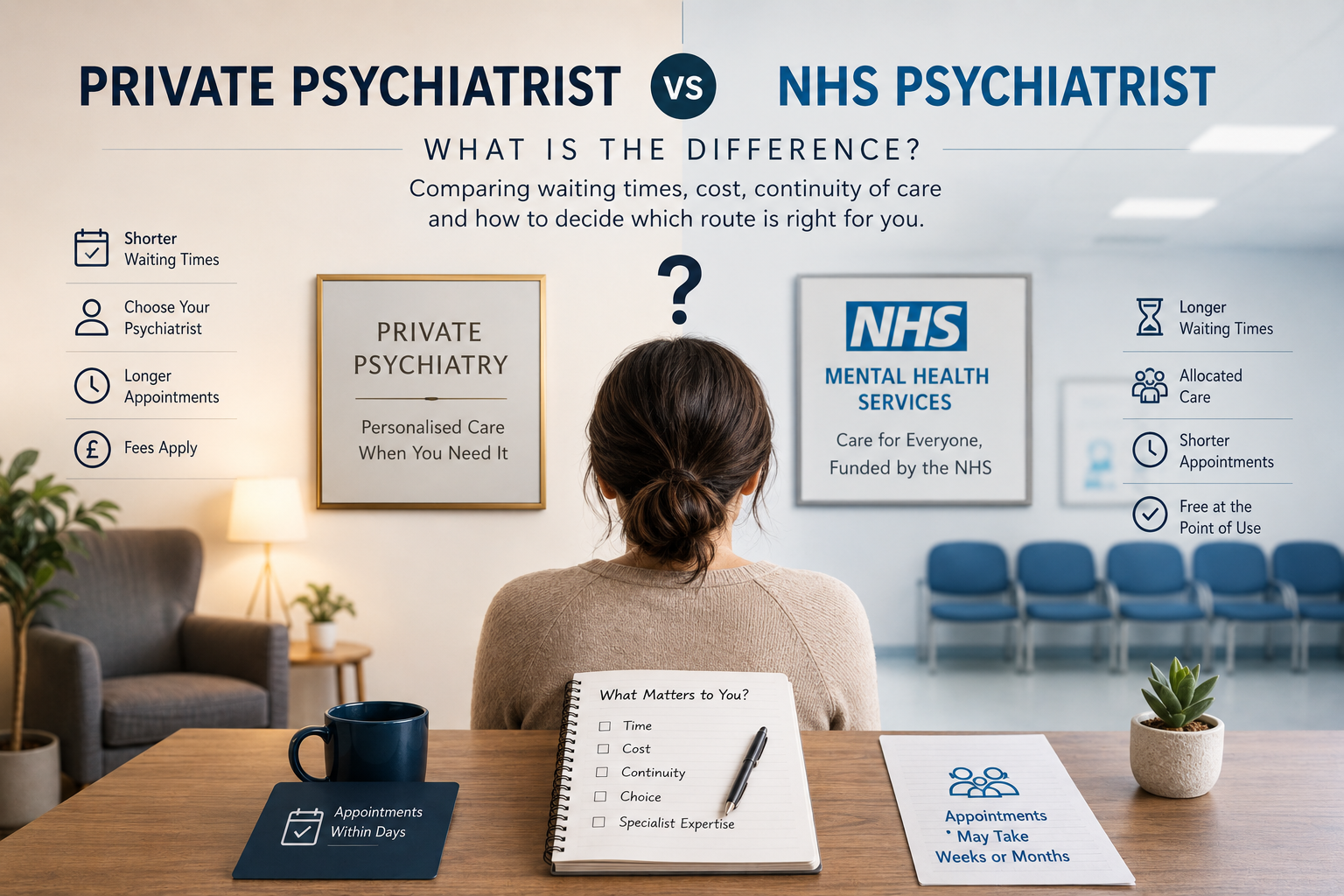
An NHS psychiatrist and a private psychiatrist are both fully trained medical doctors — same medical degree, same core psychiatric training, same ability to diagnose and prescribe. Nobody is getting a “lesser” doctor by going private, and nobody is getting a worse one by staying on the NHS. The real difference is access: how soon you’re seen, how much choice you have over who you see, how long each appointment runs, and who foots the bill.
NHS care is free but usually starts with a GP referral and a wait. A private psychiatrist generally means booking directly, being seen much sooner, and paying for that speed yourself or through insurance.
Getting a referral in the first place
The NHS route almost always starts with your GP. They’ll assess whether your symptoms meet the bar for a referral to community mental health services or a psychiatrist, and once that referral goes in, you join a queue. How long that queue is depends heavily on where you live and how your symptoms are triaged — it can be a few weeks, or it can stretch well past six months, particularly for anything not flagged as urgent.
Private psychiatry skips that gatekeeping step entirely. You don’t need to persuade anyone that your symptoms are “bad enough” to warrant a referral — you simply book. Most private clinics are happy to see your GP notes if you have them, but they’re not asking for permission first.
Waiting times: the biggest difference between a private psychiatrist and NHS psychiatrist
If you strip away everything else, this is usually what tips the decision. NHS mental health services have been stretched for years now, and it’s not unusual for patients to wait several months between referral and their first appointment with a psychiatrist, especially for non-crisis cases.
Private psychiatry, by design, moves faster. An initial assessment within a week — sometimes days — isn’t unusual. That speed matters more for some conditions than others. Depression that’s left untreated tends to deepen. Anxiety that isn’t addressed tends to generalise. And a bipolar mood episode caught early is a very different thing to manage than one caught six months in.
How long you actually get with the psychiatrist
NHS psychiatrists are frequently managing large caseloads, and that shows up in appointment length — slots can be short, and depending on the service, you might see a different clinician at each visit rather than building a relationship with one person over time.
Private appointments tend to run longer, often 45 minutes to an hour for an initial assessment, and continuity is usually part of the offer — you see the same psychiatrist at every follow-up. If you’ve ever had to re-explain your entire history to a new clinician because the previous one rotated off your case, you’ll know why that continuity is worth something on its own.
What it costs
NHS psychiatric care is free at the point of use. That’s not a small thing — for a lot of people, it’s the only reason private care even enters the conversation as “the other option,” and for many, the NHS remains the right and sufficient route.
Private psychiatry is paid for out of pocket or through insurance, and pricing varies by clinic and by how complex the assessment is. As a rough guide, an initial consultation in London tends to sit in the low hundreds of pounds, with follow-ups priced lower than the first session. Always check a clinic’s published pricing directly rather than assuming — it does vary. You can also find general guidance on NHS mental health referral routes and waiting standards on the NHS website.
Whether you get to choose who treats you
On the NHS, you’re generally allocated whichever psychiatrist has capacity in your local trust. You don’t usually get to pick based on their specific area of expertise.
Privately, you can choose someone based on what they actually specialise in — ADHD, eating disorders, PTSD, child and adolescent psychiatry, whatever’s relevant to you — and look into their background before you book. That’s a bigger deal than it might sound. A psychiatrist who regularly assesses bipolar disorder, for instance, will generally recognise it faster and with more confidence than someone seeing it occasionally among a broad general caseload.
Prescribing and ongoing medication
Both NHS and private psychiatrists prescribe from the same range of medications — a private prescription isn’t some different, more exclusive drug list. What changes is the rhythm of care. A private psychiatrist you see regularly can fine-tune a medication plan more responsively, simply because getting an appointment isn’t the bottleneck it can be elsewhere.
Worth knowing: once your treatment settles into something stable, repeat prescriptions can often be handed back to your NHS GP, which brings ongoing costs down. It’s a reasonable thing to raise directly with your psychiatrist.
So, private psychiatrist or NHS psychiatrist — which makes sense for you?
There isn’t a universal right answer here, and anyone who tells you otherwise is oversimplifying it.
The NHS route tends to make sense if your symptoms aren’t urgent, if cost is a genuine constraint, and if you’re comfortable working within your local team’s structure and pace. It remains, for most non-urgent presentations, a perfectly good and often the right choice.
Private psychiatry tends to make more sense if waiting isn’t really an option, if you want to choose someone with specific expertise in what you’re dealing with, if longer appointments and continuity matter to you, or if you can reasonably afford it — whether out of pocket or through insurance.
A fair number of people end up doing both: a private assessment to get a diagnosis and treatment plan moving quickly, then handing ongoing prescribing back to their NHS GP once things have stabilised. It’s not an either/or as often as it might first appear.
Frequently asked questions
Do I need a GP referral to see a private psychiatrist?
No. Most private psychiatrists in the UK accept direct bookings without a GP referral, although bringing existing GP notes to your first appointment is helpful if you have them.
Is a private psychiatric diagnosis recognised by the NHS?
Yes. A diagnosis made by a GMC-registered psychiatrist is clinically valid regardless of whether the assessment was private or NHS-funded, and can inform your ongoing NHS care.
Can I switch between NHS and private psychiatric care?
Yes. It’s common to start privately for speed, then transition ongoing management, including repeat prescriptions, back to the NHS once things are stable.
How much does a private psychiatrist cost in the UK?
This varies by clinic and by the complexity of your case. Always check a clinic’s published pricing directly, as costs differ for initial assessments versus follow-up appointments.
If you’re trying to decide right now
If waiting is the thing standing between you and actually getting help, that’s usually the clearest signal that a private psychiatrist is worth exploring — not as a permanent replacement for NHS care, but as a way to get assessed, diagnosed, and started on a treatment plan without losing months in the process. Weighing up a private psychiatrist vs NHS psychiatrist doesn’t have to be a one-time decision, either — you can always fold ongoing care back into the NHS once things are on steadier ground.
This article is for general information and does not replace individual medical advice. If you are experiencing a mental health crisis, contact emergency services