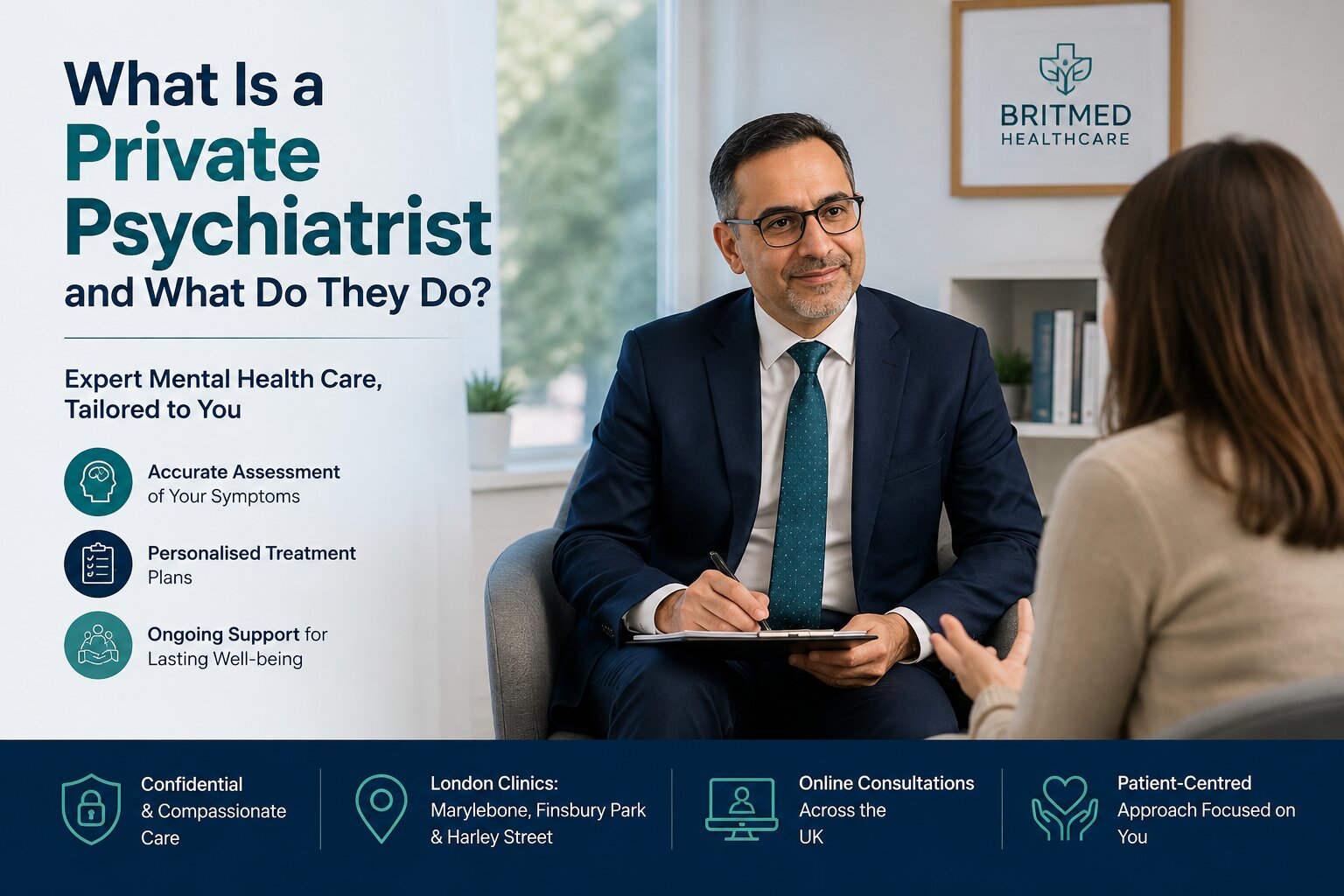
If you’ve started looking into seeing a private psychiatrist, there’s a good chance you already know something needs to change — you’re just not entirely sure what the process actually involves, or what a psychiatrist can offer that other kinds of support can’t.
Put simply, a psychiatrist is a medical doctor who has gone on to specialise in mental health. That medical background matters: it means they can assess your symptoms, work out what might be causing them, talk through the treatment options available, and prescribe medication if it’s clinically appropriate.
People turn to private psychiatric care for all sorts of reasons — wanting a specialist opinion, needing a second look at an existing diagnosis, dealing with a particular condition that hasn’t shifted, or simply wanting ongoing support without a long wait. For anyone who’d rather not travel to a clinic, Prof. Ahmed El-Missiry also offers confidential online psychiatric consultations across the UK.
📅 Prefer face-to-face or online? Both options are available — visit elmissiry.com to see what fits your needs.
What Does a Private Psychiatrist Actually Do?
It’s a common misconception that a psychiatrist hears one symptom and hands you a prescription. In reality, a proper assessment is much broader than that.
A psychiatrist looks at the whole picture — your current symptoms, yes, but also your mental health history, physical health, any medication you’re already on, family history, how you’re sleeping, what’s going on at work, your relationships, and how all of this is playing out in daily life. Two people with similar symptoms can end up with quite different treatment plans once that fuller context is taken into account.
Depending on what’s brought you in, a psychiatrist might:
- Assess your current mental health symptoms
- Help clarify a diagnosis, or reconsider one you already have
- Review medication you’re currently taking
- Prescribe or adjust medication where it’s clinically appropriate
- Recommend psychological therapy alongside or instead of medication
- Put together a treatment plan tailored to you
- Follow up over time to see how things are progressing
- Offer a second opinion on an existing diagnosis or treatment plan
With Prof. Ahmed El-Missiry, the first consultation covers a full psychiatric assessment, a review of your medical and psychological history, a diagnostic evaluation, and treatment recommendations built around your specific situation — not a generic protocol.
When Should You Actually See a Private Psychiatrist?
There’s no single symptom or checklist that tells you it’s “time.” That’s part of what makes this decision hard for a lot of people.
A reasonable starting point is this: if changes in your mood, thoughts, behaviour, or concentration have been going on for a while — or have started affecting your relationships, your work, your sleep, or just your general quality of life — it’s worth having that properly looked at.
Some of the more common reasons people book an appointment include:
- Persistent anxiety or worry that doesn’t seem to ease off
- Low mood or depression that’s stuck around longer than expected
- Trouble concentrating or keeping on top of everyday tasks
- Suspected ADHD, in adulthood or adolescence
- Intrusive thoughts or compulsive behaviours
- Noticeable mood swings
- Symptoms linked to a past trauma
- Sleep problems that have gone on for months, not just a bad week
- Difficulties related to alcohol or substance use
- Wanting a second opinion on a diagnosis you’ve already been given
It’s worth saying clearly: having one or two of these on your own doesn’t automatically mean you have a specific condition. That’s exactly what the assessment is there to work out — not to slap a label on things, but to understand what’s actually going on.
What Happens in a Private Psychiatric Assessment?
For most people, that first appointment is really just a chance to sit down and talk properly with someone who knows what they’re looking for.
You’ll likely be asked when things started, how they’ve changed over time, and what impact they’re having day to day. Your psychiatrist may also ask about past treatment you’ve had, your physical health, current medication, your family’s mental health history, and your sleep.
Before the appointment itself, you’ll usually be sent a questionnaire covering your symptoms and background — this gives your psychiatrist a head start, so more of the actual consultation can be spent talking rather than filling in forms.
From there, the conversation goes deeper into your specific answers. The goal isn’t to rush toward a diagnosis for its own sake — it’s to understand the pattern behind what you’re experiencing, so the right kind of support can be worked out.
If you already have a fairly good idea of what you want assessed, there are also dedicated pages for ADHD assessment, depression assessment, OCD treatment, bipolar assessment, and PTSD and Complex PTSD assessment.
What Conditions Can a Private Psychiatrist Help With?
Psychiatry covers a lot of ground, and what’s “right” really does depend on the person in front of the psychiatrist, not just the diagnosis on paper.
Prof. Ahmed El-Missiry’s practice covers ADHD, anxiety, depression, PTSD, bipolar disorder, OCD, insomnia, and addiction, among other areas.
ADHDADHD tends to show up as difficulty with attention, organisation, impulsivity, and managing time — and it doesn’t always look the way people expect. Assessments are available for both adults and adolescents, including a computerised ADHD assessment component. |
DepressionDepression is often reduced to “feeling sad,” but it can chip away at motivation, concentration, sleep, appetite, energy, and your ability to enjoy things. Assessment looks at severity, duration, and the right treatment approach. |
OCDOCD can involve intrusive thoughts alongside repetitive behaviours or mental rituals used to manage anxiety. Treatment typically draws on CBT and Exposure and Response Prevention (ERP), with medication where appropriate. |
Bipolar DisorderBipolar disorder involves shifts between mood states — depression alongside episodes of mania or hypomania. Assessment looks closely at mood patterns, behaviour, and personal history before recommendations are made. |
PTSD & Complex PTSDTrauma has a way of staying with people long after the event — affecting thoughts, emotions, sleep, and a basic sense of safety. Assessment looks at intrusive memories, nightmares, avoidance, and hypervigilance. |
InsomniaSleep problems that drag on for weeks or months can affect mood, concentration, and daily functioning. Treatment starts with understanding your sleep patterns and what’s driving the problem. |
Psychiatrist vs Psychologist — What’s the Actual Difference?
These two get mixed up constantly, and it’s easy to see why — but their training and what they’re able to offer aren’t the same.
A psychiatrist is a medical doctor who has gone on to specialise in psychiatry. Because of that medical training, they can assess mental health conditions and prescribe medication where it’s needed.
Psychologists, on the other hand, specialise in psychology rather than medicine, and typically focus on psychological assessment and talking therapies rather than prescribing.
Plenty of people end up benefiting from a combination of the two — psychiatric input alongside psychological therapy — rather than having to choose one over the other.
Can a Private Psychiatrist Prescribe Medication?
Yes — as medical doctors, psychiatrists are able to prescribe medication when it’s clinically appropriate.
That said, seeing a psychiatrist doesn’t automatically mean you’ll walk away with a prescription. Whether medication comes into the picture at all depends on your symptoms, diagnosis, medical history, anything you’re already taking, and your individual circumstances. Depending on what the assessment shows, treatment could involve medication, psychological therapy, changes to lifestyle, ongoing monitoring, or some mix of all of these.
Follow-up appointments are where a lot of the fine-tuning happens — reviewing how symptoms are responding, whether treatment is actually working, and adjusting course if it isn’t.
Why Do People Choose Private Psychiatric Care?
The reasons vary quite a bit from person to person. Some want the input of a specialist. Some want an independent opinion separate from a diagnosis they’ve already been given. Others simply value the flexibility that comes with private appointments — being able to book in at a time that works, rather than waiting.
Online care has become a genuinely convenient option for a lot of people, too. Prof. Ahmed El-Missiry offers secure online psychiatric consultations across the UK, so you can speak with a psychiatrist without needing to travel to a clinic at all.
The approach throughout is meant to be personalised and grounded in evidence, with follow-up care available where it’s useful — rather than a single appointment and nothing after.
How Do You Actually Choose a Private Psychiatrist?
This isn’t a decision to rush, particularly given how personal the conversations tend to be. A few things worth checking before you book:
- Relevant experience — has this psychiatrist actually assessed or treated the kind of condition you’re dealing with, regularly, not just occasionally?
- Professional credentials — is their registration and qualification something you can check and confirm?
- How the assessment is structured — will you actually get enough time to properly explain your symptoms and history, or does it feel rushed?
- What happens next — is there a clear path after the first appointment, and is follow-up care actually available if you need it?
- How you’ll meet — if in-person isn’t practical for you, is a secure online option genuinely available?
Above everything else on this list, the most important thing is finding someone you actually feel comfortable being honest with.
Getting Ready for Your Appointment
You don’t need to turn up with a perfectly organised medical history — that’s not what’s expected of you.
A rough list is usually enough. It can help to jot down:
- What’s mainly concerning you right now
- Roughly when it started
- Any medication you’re currently taking
- Diagnoses you’ve had in the past
- Any previous mental health treatment
- Physical health conditions worth mentioning
- Changes to your sleep or mood
- How it’s affecting work, relationships, or everyday life
- What you’re hoping to get out of the appointment
If you have old reports or relevant medical records to hand, bringing them along can give your psychiatrist useful background from the start.
Frequently Asked Questions
Is a private psychiatrist a real doctor?
Yes. A psychiatrist is a medically qualified doctor who has gone on to specialise in mental health.
Can a private psychiatrist diagnose ADHD?
Yes. They can carry out a specialist ADHD assessment and determine whether your symptoms meet the recognised diagnostic criteria.
Can a private psychiatrist prescribe medication?
Yes, when it’s clinically appropriate — and they can review or adjust that medication during follow-up appointments as things progress.
Can I see a private psychiatrist online?
Yes. Prof. Ahmed El-Missiry offers online psychiatric consultations across the UK.
Can I book a psychiatrist just for a second opinion?
Yes — a private consultation can give you an independent view if you want another professional’s take on an existing diagnosis or treatment plan.
Final Thoughts
At its core, a private psychiatrist is a medically trained specialist who can help you make sense of what you’re experiencing, work out whether it points to a specific condition, and build a treatment plan that actually fits your situation.
You don’t need to wait until things have completely fallen apart before asking for help. If something in your mood, concentration, sleep, behaviour, or day-to-day life has shifted and stayed that way, a psychiatric assessment can at least give you some clarity on what’s going on and what your options are.
Ready to talk to someone?
Prof. Ahmed El-Missiry offers confidential online psychiatric consultations across the UK, covering ADHD, depression, OCD, bipolar disorder, PTSD, insomnia, and more.
This article is intended for general educational purposes and should not be used as a substitute for personalised medical advice or an individual psychiatric assessment.
