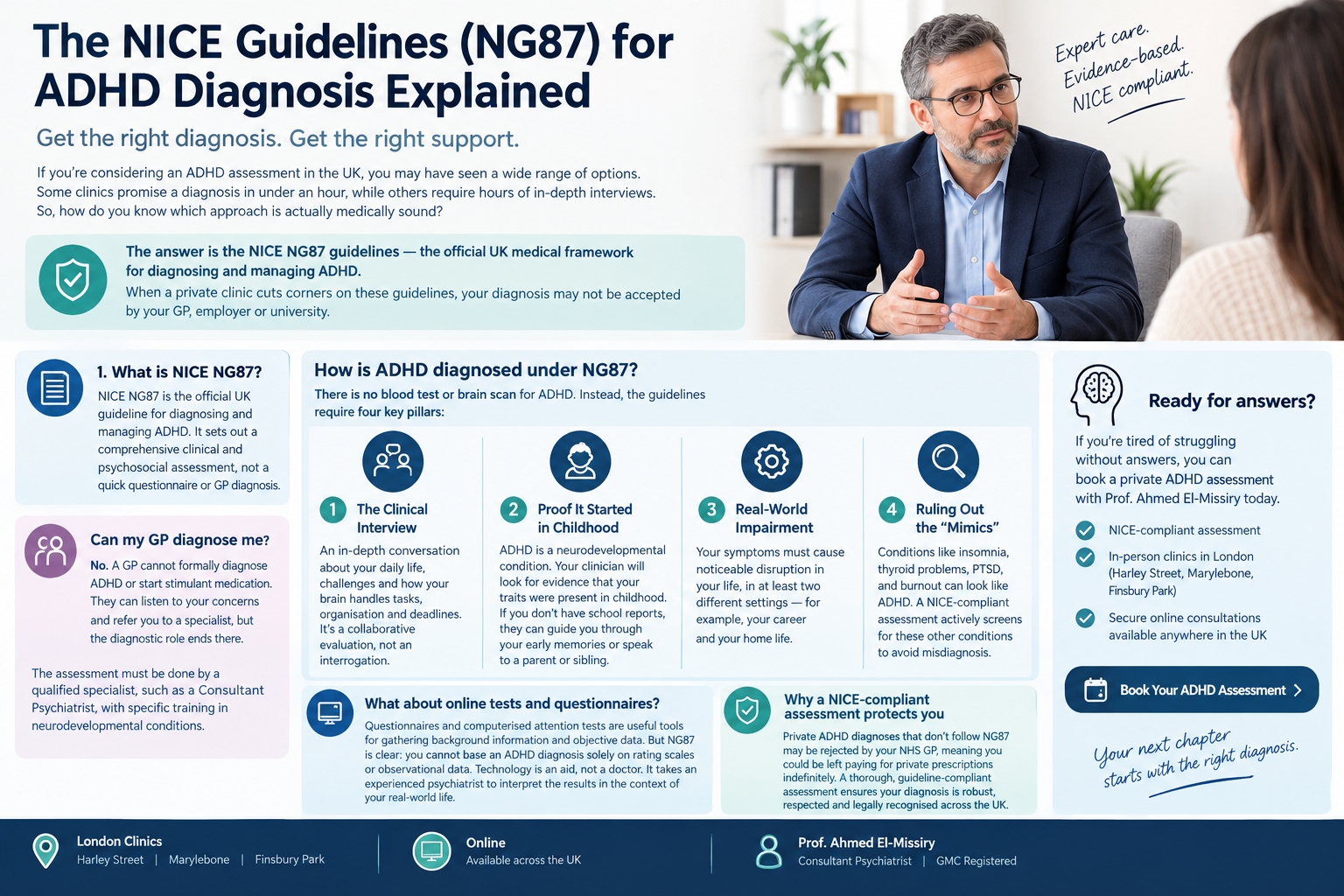
If you are looking into getting an ADHD assessment in the UK, you have probably noticed a massive range of options. Some clinics promise a diagnosis in under an hour via a quick video chat, while others require hours of in-depth clinical interviewing.
So, how do you know which approach is actually medically sound?
The answer comes down to one specific document: the NICE NG87 guidelines.
NICE (The National Institute for Health and Care Excellence) sets the absolute gold standard for healthcare in the UK. When a private clinic cuts corners on these guidelines, you risk walking away with a diagnosis that your GP, employer, or university might simply refuse to accept.
Here is a plain-English look at what NG87 actually demands from an ADHD assessment, and what you should expect when you sit down with a specialist.
What exactly is the NICE NG87 Guideline?
The Short Answer: The NICE NG87 guideline is the official UK medical framework for diagnosing and managing Attention Deficit Hyperactivity Disorder (ADHD). It dictates that ADHD cannot be diagnosed by a quick questionnaire or a GP. Instead, it requires a comprehensive clinical and psychosocial interview conducted by a qualified specialist—such as a Consultant Psychiatrist—who evaluates your developmental history, daily impairment, and mental health background.
Can my GP diagnose me?
People ask us this all the time. The short answer is no.
Under NG87 rules, a General Practitioner cannot formally diagnose ADHD or initiate stimulant medication. They can listen to your concerns and refer you to a specialist, but that is where their diagnostic role ends.
The guidelines explicitly state the assessment must be done by a healthcare professional with specific, advanced training in neurodevelopmental conditions.
This is why seeing a GMC-registered Consultant Psychiatrist is often the safest route. A psychiatrist does not just run through a symptom checklist. They are medical doctors trained to untangle complex mental health histories. If your attention issues are actually being caused by hidden anxiety, trauma, or a mood disorder, a psychiatrist will catch it. If medication ends up being the right path for you, they are fully qualified to safely prescribe and monitor it.
How is ADHD actually diagnosed under NG87?
There is no blood test or brain scan for ADHD. Instead, the NICE guidelines require your clinician to build a complete picture of your life using four main pillars:
1. The Clinical Interview
This is the core of the assessment. You and your psychiatrist will have an in-depth conversation about your daily life. How does your brain handle repetitive tasks? What happens when you try to organise your finances or meet a deadline? It is not an interrogation; it is a collaborative evaluation of how you function.
2. Proof It Started in Childhood
ADHD is a neurodevelopmental condition. Because of this, NG87 requires evidence that your traits were present when you were a child.
Do not panic if you do not have your primary school reports stashed in a box somewhere. A skilled psychiatrist knows how to guide you through your early memories to identify those early signs, and they may ask to have a quick chat with a parent or older sibling to fill in the gaps.
3. Real-World Impairment
We all lose our keys occasionally, and we all get distracted. To meet the clinical threshold for ADHD, your symptoms must cause actual, noticeable disruption in your life. The guidelines require this impairment to show up in at least two different settings. For example, your lack of focus might be jeopardising your career, while your impulsivity is causing constant friction at home.
4. Ruling Out the “Mimics”
This is where questionnaire-only services fall dangerously short. Chronic insomnia, thyroid problems, PTSD, and severe burnout can look exactly like ADHD. A NICE-compliant assessment actively screens for these other conditions to make sure you are not misdiagnosed.
What about online tests and questionnaires?
Questionnaires are highly useful for gathering background information before your appointment. Similarly, computerised attention tests are fantastic tools for capturing objective data about your impulse control.
But NG87 is incredibly strict on this point: You cannot base an ADHD diagnosis solely on rating scales or observational data.
Technology is an aid, not a doctor. A computerised test provides the raw data, but it takes an experienced psychiatrist to interpret what that data actually means in the context of your real-world life.
Why a NICE-compliant assessment protects you
Right now, the NHS is heavily scrutinising private ADHD diagnoses. If you get diagnosed by a service that did not follow the NG87 guidelines, your NHS GP will likely reject a “Shared Care Agreement.” That means you could be left paying private prescription fees for your medication indefinitely.
A thorough, guideline-compliant assessment is an investment in your long-term care. It guarantees your diagnosis is robust, respected, and legally recognised across the UK.
If you are tired of struggling without answers and want an evaluation you can trust, we are here to help. You can book a private ADHD assessment with Prof. Ahmed El-Missiry today. With in-person clinics in London (Harley Street, Marylebone, Finsbury Park) and secure online consultations available anywhere in the UK, getting an expert, NICE-compliant diagnosis is completely within reach.
Frequently Asked Questions
What does NICE NG87 mean?
NICE NG87 is the official set of clinical guidelines published by the National Institute for Health and Care Excellence. It provides healthcare professionals in the UK with the exact, evidence-based standards required to safely diagnose and treat ADHD.
Do I need old school reports for an adult ADHD assessment?
While old school reports are incredibly helpful for proving childhood onset (a requirement under NICE guidelines), they are not strictly mandatory. If they are lost or unavailable, a specialist can gather the necessary childhood evidence through a detailed clinical interview or by speaking to someone who knew you growing up.
Will the NHS accept a private ADHD diagnosis?
The NHS will generally accept a private diagnosis and enter into a Shared Care Agreement (for medication) only if the private assessment strictly followed the NICE NG87 guidelines. This is why it is highly recommended to be assessed by a Consultant Psychiatrist who conducts a full clinical and psychosocial evaluation.


 for ADHD Diagnosis Explained)